Horn Speakers for Live Sound Reinforcement |
Due to their high efficiency, low distortion and directionality, horn loaded speakers
are the undisputed king in high spl sound reinforcement applications.
However, many early poorly designed systems gave horn loading a bad name for
having a characteristic "honk" sound. Fortunately, the advent of further
research and ready availabilty of various simulation and design software packages
has produced a large number of high performance commercial systems with hifi
quality, but sometimes the stigma still lingers. For more information about horns in general, see the links page. Presented here is some information on some of the more successful horn speakers I have built over the years, and may provide some ideas or insight to others interested in this type of speaker. Click on the pictures below for more information about that speaker. |
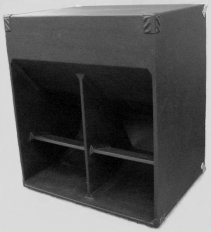
Twin 15" sub. This was designed around 1984 and is still a good performer today. Soon to be replaced with a more efficient design utilising smaller drivers. |
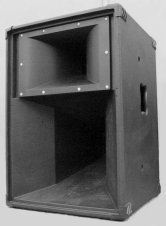
Midrange Mk II Utilising a single 12" and 2" compression driver, this replaced an earlier 12" design that didn't perform very well..... |
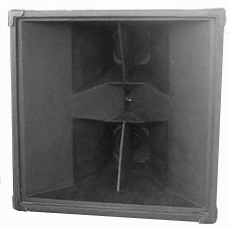
Midrange Mk III Next generation addressing upper-mid harshness of previous design, with a few other tradeoffs. Utilises 2x 8" cone drivers and 1" compression driver. |
The future - where to from here ? My aim is to push the top-end limits of cone driver horns further, in order to get the crossover to a compression driver above the sensitive vocal area - at least 3.5kHz. To achieve this, smaller diameter drivers are in order, but that it itself poses other problems. If we reduce the HF passband and widen the midrange, then more power is required for midrange in comparison - however smaller drivers are invariably rated at lower powers. In the 12" horn above, crossover points were 1.5kHz and 250Hz. This gives a fairly even octave spread through the audio range, and general power ratios for this scenario are about 3:1 for each lower band. Therefore around 130W for HF and 400W for mids. In the twin 8" design, crossover is at 2.5kHz. HF power has been reduced to around 90W and combined power of the 8" drivers is about 450W. If we push the upper crossover point to 3.5kHz, then to maintain overall system power, the midrange will need to be about 550W - tall order for 6" speakers. Solutions include multiple drivers and splitting the midrange into upper and lower bands (ie. 4-way). Promising experiments currently underway include investigation of the Eminence Alpha6 speaker. This has relatively high Fs and a power rating of 100W RMS - obviously short of the 550W requirement. To keep up with the HF, I will be looking at using two of these drivers and splitting the bands 4-way. For an evenly spread 4-way system, power ratios can come back to 2:1. Therefore, 90W or so on HF will match with around 200W hi-mid and 400W lo-mid. Reasonable bands for this condition would be subs to 150Hz, lo-mid to 500Hz, hi-mid to 3.5kHz. Whilst the upper crossover point objective has been achieved, I am currently refining the dispersion. Will also look at using dual Beta8 for lo-mid band. Of course, with all this redevelopment on upper frequencies, the old dual 15 subs may be a bit pressed to keep up, plus they have greater bandwidth than what is required anyway. So nearing prototyping are two new sub designs utilising 12" and 10" speakers. Initial simulation so far suggests that these will outperform the old 15s both in efficiency and low end extension, as well as being lighter and cheaper Cheers - stay tuned ....... |

Construction plans available for this box ! |
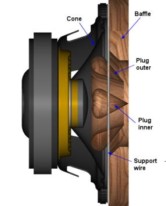
Phase Plugs A number of my midrange horns use phase plugs. This article attemps to explain how they work and how I make them. |

Bass Horn Folding For those with access to AutoCAD, this article describes how I fold up a bass horn. Includes a downloadable spreadsheet to calculate the segments. |